Tuesday, January 22, 2013

Sunday, January 20, 2013
Saturday, January 12, 2013
Headspace - Andy Puddicombe
From Huffpost
The Wisdom of Uncertainty
Posted: 01/07/2013 12:03 pm
In an uncertain world, it is only natural that we should search for certainty. It provides a feeling of comfort, of safety, perhaps even a sense of purpose or belonging. In a world where everything is constantly changing, where people, places, situations and even our very own mind is in a constant state of flux, the illusion of certainty is highly appealing.
But it's important to differentiate between what we know and what we believe, what we know and what we suspect, and what we know and what we've been told. Because what we actually know is only what we experience, no more and no less. If we let go of everything we have ever read, have ever heard, or have ever told ourselves to be true, we are left with nothing but our experience. In fact even this is constantly changing, as each moment, each experience, gives way to the next.
So we are left with nothing but the experience of the present moment, the certainty of now.
For some, this type of reflection is a revelation, a cause for celebration, an opportunity to let go of old baggage and the vehicle to a renewed sense of wonder and curiosity in life. This is of course accompanied by the sound of collective consciousness breathing an enormous sigh of relief as each and every one of us realizes that we no longer need to pretend to have all the answers. Phew.
For others, it is the cause of heart palpitations, rising blood pressure and sweaty palms -- in short, an overwhelming desire to engage with thought, to sidestep fear, to repeat a well-rehearsed opinion in the mind, to hang on to the remnants of belief and to sure up any illusion of certainty we might cling to. Anything, literally anything, to avoid peering into the chasm of uncertainty that is life itself.
But there is no shame in not knowing, there is only freedom. An uncertain mind is an open mind. It is a mind which is curious, interested, reflective and malleable. When we meet life with a genuine sense of uncertainty, we cease to project that which we think we know and instead begin to see life for what it really is. The same goes for the people around us. It is only in letting go of our preconceptions and opinions of others that we allow them to be who they truly are, to change and evolve from one moment to the next.

This is the wisdom of uncertainty.
It is not a rejection of the human intellect, it does not disrespect the opinion of others, nor does it negate or devalue the experience of others. If anything, it fosters the search for greater intellectual understanding, whilst embracing the ideas of others. In this way, it offers the opportunity for a calm and considered response to the events of life, resolution where there is conflict and peace where there is war.
But the wisdom of uncertainty nonetheless highlights the importance of experiential understanding. To think about contentment is one thing, to be content is quite another. It is not enough to simply believe, we need to discover, to find out for ourselves. It is not enough to suspect, we need to feel, to know it personally and intimately.
Just to be clear, this is not about thinking about uncertainty, which is no more than doubt and confusion. On the contrary, this is the direct experience of uncertainty itself, from moment to moment, free from thought, judgment, opinion or analysis. It is nothing less than naked awareness, the nature of mind, life itself, unfolding before our eyes.
If you'd like to find a way of feeling less stressed and more content in your life, why not commit 10 minutes a day to looking after the health of your mind. In fact why not set yourself the Mind Man Challenge and see if you can do 10 minutes every day for 10 days. I've recorded a special programme, which is completely free to use and which you can access online or as an app on your iPhone or Android.
Simply visit www.getsomeheadspace.com to sign up to the challenge and make today the day you commit to giving the mind the TLC it deserves.
wkup.org - Gross National Happiness
Talk and Q & A with Dr. Ha Vinh Tho
(Dharma Teacher in the Plum Village Tradition,
Program Coordinator at the Gross National Happiness Centre in Bhutan)

// TALK //
There is a
potential to create relationship with what’s going on in Bhutan and the
Wake Up movement. We share common interests and practices. Hopefully
this is a beginning of cooperation with young people in Bhutan and the
Wake Up movement.
I will walk
you through certain aspects of GNH in the light of Buddhist teachings; I
will try to make it as practical and concrete as I can.
Why GNH? Why do we need to approach the economy and the social system differently than we have done until now?
We can understand the need for a new economic paradigm in the light of the Four Noble Truths, from the first teachings of Buddha:
First Noble Truth: Suffering
This has to
do with having courage to acknowledge the suffering in ourselves and
outside ourselves. Difficulty of acknowledging suffering around us is
that it could create despair, discouragement and anger. It is important
that we have the courage to look directly at the suffering in our own
mind and in the world and yet not get overwhelmed by it but, on the
contrary, that it becomes a source of energy to transform suffering into
Compassion and Understanding.
Three numbers to describe the suffering:
1 million -
the number of people that take their own lives every year. Most of
them are young people. The majority of them come from rich, affluent
countries. There are more young people that take their lives every year
than those that die from war. I have traveled to so many countries that
are war-ridden and seen a lot of war and suffering. When I realized that
more young people from rich countries are taking their lives than in
war, it was a shocking realization for me. This is the first number and
it points to the suffering that individuals go through and it speaks of
the meaninglessness of some lives.
(own notes: there are 40-42 million sex workers in the world.. demand is scarier than supply..)
(own notes: there are 40-42 million sex workers in the world.. demand is scarier than supply..)
2.5 billion
- the number of people living underneath the poverty line on this
earth today. Technology, science and progress have created more wealth
than ever before, and yet 2.5 billion people live below the poverty
line. These people are at any time in danger of not having food or
water. We are not speaking about the ones who do not have access to
comfort but of the ones who lack basic resources.
1.5 -
the amount of earth we are using every year. The earth needs 18
months to produce what we consume in 12 months. We are using 1.5
planets, but we only have 1 earth.
These three
figures have to do with suffering on personal level, social level and
planetary level. Why then GNH? We need to promote a different approach
to economic development and progress; one that really puts the human
being and his happiness in the centre of all policies to address these
issues and transform suffering and offer alternatives on all three
levels.
It has to
begin with personal level, transformation of the self. But it needs to
have an impact on all levels: my immediate surrounding family and
friends, then on the society at large, and finally on the planet. It is
important to always keep in mind the need for this multilevel
transformation process. The crucial question is: how do we approach
transformation of suffering on all levels; Individual, immediate
surrounding, country, and the way we live on planet earth?
We start
with the diagnostic so we can identify the suffering. So far, I’ve
identified it from the outer perspective. But what each one has to do
for himself or herself is to look honestly inward and figure out; what
is my own suffering, what is my own confusion, and how does my own
suffering contribute to the suffering of the world?
We then move on to the Second Noble Truth:
Second Noble Truth: Identifying the causes of suffering
There are
inner causes and outer causes. We need to look at both simultaneously.
Many of the social movements we have seen in the recent past try to
address the outer causes and often forget the inner causes of suffering.
Many of you have seen the calligraphy by Thây: “There no way to
happiness, happiness is the way”. I think this is a crucial point. We
cannot reach happiness by adding more suffering, fear or anger. We need
to find peace in ourselves to bring about outer transformation.
There are three causes of suffering (The three poisons of the mind ):
1. Ignorance.
The Sanskrit word “Avidya” literally means absence of light, of
wisdom, of understanding. This is fundamentally the illusion that one
can attain happiness while making others suffer. This is ignoring the
reality of interdependence of the world. The need to destroy others to
be the best, the richest. This is the illusion of separate self; that
my happiness can come from disregarding completely the suffering of
others. Awakening, enlightenment is the act of shedding the light of
mindfulness on the reality of interdependence of life. Your happiness
is my happiness. Your wellbeing is my wellbeing. This is wisdom,
understanding (Prajna in Sanskrit).
2. Greed. Gandhi famously said 'the earth could produce enough to satisfy all her children’s needs, but not all the people’s greed.'
There is enough food to feed every single human being on the planet.
The problem is not that we don't have enough - it is that we don’t
distribute properly. Some of us take so much and do not share, and do
not care that others suffer. Imagine having a birthday cake and I take
80% of the cake, and all others have to share the 20%. This is exactly
what the West is doing. The West is taking up 80% of the earth’s
resources.
When
I honestly look at myself – why am I getting greedy, why do I feel
compelled to buy more, to consume more? Deep down it is triggered by a
feeling that there is a vacuum in me; that I am not quite fulfilled, I
am not quite complete. I hope this experience, this object will make me
complete, will somehow overcome this feeling of dissatisfaction.
So,
consumerism is the result, not the cause of the problem. But on the
other hand, consumerism is one of the major causes for the depletion of
the natural resources of the earth. The deeper cause is the lack of
meaning in our lives, the lack of purpose. So we buy things to fulfill
that void. The satisfaction I get from getting a new thing is very
short-lived. Still, I find myself falling into the trap again of wanting
a new item- each one has his own favorite thing. Greed is very
powerful, and our society is geared towards strengthening greed. The
whole marketing/advertising business is trying to convince us that greed
is good because it enables growth. And growth is what the economy
needs. If you consume, you are a good citizen because it promotes growth
and the economy will be well off. This is the way things have been for
decades, and we recognize it has not brought happiness. Yet it has been
difficult to overcome this want for more.
I
believe the worst is when it manifests on the human level – we find it
difficult to create true relationships, long-term relationships, true
friendship and true love. The other person is used to bring me
fulfillment, and I don’t actually acknowledge him or her. The other
person is considered as an object to fulfill my own needs. This seems to
work for a short time, but when things get boring, we jump to the next
person, the next experience, just the way we move from one object to the
next. Until we look seriously into what it is we are looking for, it is
difficult to create a long lasting meaningful relationship. So I dare
to say that Lisi and I have been together for over 40 years now - it was
not always been easy and simple but it was a relationship based on
values, common commitments, ideals, and the understanding that her
happiness is the key to my own happiness and vice versa. I’m not saying
this to look good, just saying this as a testimony that it is possible
and if we could do it, you can do it too.
If
our greed becomes less because our mindfulness grows stronger, purpose,
morality, we consume less. Statistically, each of us has to consume 1/3
less. If each of us does that, the earth can survive. So it is not by
consuming more that we will become more happy, it is by being happier
that we will consume less, and therefore lessen the pressure on the
environment.
3. Violence.
Hatred, aggression. It starts with negative, aggressive thoughts,
that become violent words, then manifest into violent actions. Mind,
speech and action escalating to wars. We see that our governments are
spending hundreds and hundreds of billion dollars every year on
weapons. Weapons are a physical manifestation of fear and aggression.
If I have no fear, I have no aggression. If I have no aggression, I
don’t need weapons. If we could reduce our fear by a fraction, we could
reduce the money we use on weapons; we could use the money to feed all
the hungry children in the world. We cannot reduce fear and aggression
in the world until we reduce it within ourselves. Most of us have not
killed, but all of us have the seed of violence. We probably have had
violent thoughts and even spoke violent words to others. We sometimes
think it is legitimate to say violent things. This is the seed of
violence that can grow to become guns, to bombs. We must start by
transforming the violence that is in our own mind.
This allows us to look at the third noble truth.
Third Noble Truth – State beyond suffering
There is a
state beyond suffering. It is important for us to realize that this
state is not such a far away world that we can only reach after 99 years
of meditation in a cave. It is readily available and we can create it. I
would like to emphasize the collective dimension here. It is not only
about myself overcoming my own suffering on my own, it is about creating
a community, a society, that is conducive to generating Mindfulness and
Happiness. You have heard about the mindful practices required for the
achievement of happiness. But I would like to emphasize the community,
the collective.
Han has visited us in Vietnam – the Peaceful Bamboo Family (s. Eurasia Association) is
such a place where all kinds of people, ‘normal’ and with disabilities,
young and old, people from all kinds of backgrounds can live together
in harmony. It is nowhere near perfect, but it is a community that is
committed towards this goal of living in harmony. Plum Village is also a
place where not only people try to live in harmony, but is dedicated to
teaching how to do so.

// QUESTIONS & ANSWERS //
Written Questions
What is GNH?
It is an
effort to create the conditions that enable for a community to live in
harmony, not only in a small scale, but on a nationwide scale. And this
is the innovative dimension on GNH. To promote a practice and a
lifestyle that is centered on the deeper needs of people, all beings and
the planet. And we need to promote an economic system that is based on
these values because the economy plays a major role, so if we do not
change the economy, we cannot change life and society.
Is it easy?
No. Is it a success? Not yet. You can’t say Bhutan has achieved it, but
Bhutan is on the path. And by being on the path, it is showing the
world that there is an alternative option to an economy based on
competition and greed. An economy centered on ethical values and
respectful of our planet.
At the GNH
Center, we are trying to create such a place, where GNH can be
experienced. We want to offer people an environment that is permeated by
these values, the way we build the centre in a fully ecological way,
the way we run it in an environmental friendly manner, the way we
practice together so that people have a transformative experience and
bring this experience back into their own communities. We hope that by
and by there will be GNH Centers in many places on earth.
What is the way to transform suffering into happiness?
There are three main components:
-
Wisdom. Knowledge of Self: Prajna. The power to turn our mindfulness inward and understand our own mind and the way we function in order to transform it. And then applying these insights into our daily lives. Buddhism is a path of liberation through understanding. This understanding must be manifested into the way I speak, the way I act, the way I deal with friends and family, the choices that I make in my life.
-
Discipline, the practice: Sila. If we take our understanding seriously, we need to put it into action in our every day lives. I suppose many of you have taken the 5 mindfulness training and that is a good basis for an ethical life. GNH is the effort to find this global ethics on a national level. We look at the way the government functions, the way the society functions in the light of mindfulness, of ethical values.
-
Mindfulness, Concentration, Meditation: Samadhi. These are the tools that we are given to enable us to go though the transformation process. If we practice mindfulness and meditation daily, our understanding grows, and our practice grows. We need to transform from both sides, inner and outer. There is a need to change our environment that is conducive to the transformation. We need to take steps, bold steps to go through with it.
I would like to share with you my personal experience. I used to work with ICRC (International Committee of the Red Cross).
I decided to change work, and got 2 offers simultaneously. One was from
a big power company in France. One of the directors told me that there
is so much suffering in the employees, and he would like to change that.
Good salary - $20,000/month, free house, etc. This was quite tempting. I
would be helping 160,000 employees and make the most amount of money I
ever had.
And then I
got another offer from the GNH Centre – the salary was a third of what I
used to make, a fraction of what was being offered by the electric
company. I had a moral dilemma: the French company is running 150
nuclear power plants, and I have always been ecologically engaged, and
working for this company was going against my morals. So I decided to go
to Bhutan.
Looking at
this from a purely material perspective, this was a huge sacrifice. My
buying power dropped considerably, but it was a boost for my mental
well-being. Material wealth and mental well-being are very different
things. This choice brings me much more happiness; to be aligned with my
values and morals and having the feeling that I can contribute (even
though modestly) to the happiness of all beings brings me a deep
satisfaction.
This is to
convey to you that it is not difficult to make the right choices - it
just takes a little courage. It is so rewarding that you would not
regret these choices.
Going back to GNH – I was asked:
What is your definition of happiness?
I don’t
think there is a definition, I don’t think there needs to be one.
Happiness is an experience. If you have the right practice, surround
yourself with the right people, create an healthy environment, then you
experience happiness; then you reflect on what made you happy and you
come to a deeper understanding. When I look at myself and my life and
what made me truly happy, it is not difficult to identify the causes of
my happiness.
Happiness can be three things:
-
State of mind/emotion - which is temporary, more pleasure than happiness.
-
Trait or character - an optimistic person who seems happier, satisfied with life, and this is more trait of character often connected with childhood experiences and karma.
-
Happiness as a skill – This is the most important; because it is a skill, you can cultivate it, learn it and spread it. This is what I’m interested in, that happiness can be learned and cultivated. For example, compassion is a key element to happiness and if I look back at my own life, and when I had the opportunity to alleviate suffering of others, simple things to big things, both bring me as much happiness. Compassion doesn’t only manifest when we can do big things. It can be manifested modestly. Compassion is a very important aspect of happiness. Everything that we do to bring happiness to others is a source of happiness to self.There was an interesting study done recently. A group of people got money to do what they want with it. They then followed up with the people who got the money and how they felt about it. All the people who spent it on themselves had lost the satisfaction rapidly; but the people who did something for others with the money had a much longer lasting happiness. So there is a lot of research on happiness – psychological, sociological and economical. I was at a meeting where many researchers shared their research and I can share that with you. But, don’t take my word for it – look back and try to really see what the causes of not just short lasting pleasure but long lasting happiness, and share those experiences.
How can we measure happiness?
If we are speaking of GNH, we are speaking of something more comprehensive than the passing emotions people feel. There is the World Happiness Report you can find online (by Jeffery Sachs and Lord Layard).
Happiness
Measurement in GNH is a mix of objective and subjective factors.
Objective measures include dimensions like health, education, community
vitality, natural environment and more. But we should not underestimate
the subjective factors of psychological well-being, and find the mix of
the two. For example, some of you wear glasses. You go to the
optometrist, then he will show you the letters and will ask you if you
to see better or worse with different glasses. Your answers can be
described as subjective, he has to take your word for it but they are
objective enough so that you can get a pair of glasses that work. So
don’t think only hard, material quantitative evidence can be used as
scientific evidence.
I won’t go
into the 9 domains and the 72 indicators of GNH. I will instead send you
links on what they are. When you read up, you can see how the
measurement is done. It is scientific, it is not wishy-washy.
What are the four pillars of GNH?
First pillar: Sustainable development.
The economic development should directly be connected with the
preservation of the environment. As soon as you realize happiness
includes happiness of every other organism and mother earth, there is no
way to get around sustainable development. It is an economic paradigm
that enables the conservation of the environment. But it also includes a
fair distribution of resourses.
Second Pillar: Preservation of the Environment. Bhutan
is the first country in the world to go 100% organic. This is a
concrete example of sustainable development. It is possible. Don’t
believe those who say you need fertilizers and GMOs in order to feed the
world.
Third Pillar: Preservation and Promotion of Culture and Spirituality. Happiness
strongly depends on cultural values and practices. One of the
indicators is time use. People in developed countries have higher
standard of living, but less time for family and friends.
Fourth Pillar: Good Governance. This
is a political pillar. How do we promote a government that puts the
right things in priority? This is our responsibility as a citizen to
choose the right government. The goal is to create happiness and
well-being. These are the basics and I will send you the links to the
details.
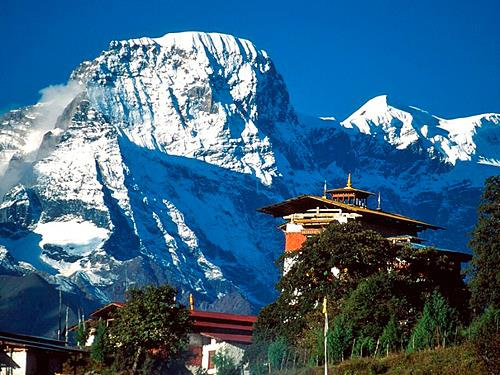
Oral Questions
Q1 // Simon Question
on the noble truths of Buddha. Another cause of suffering in myself is
that when you are confronted with suffering of the world, that makes me
panic and want to fix it right away. I am very interested in how you
can react to this kind of data in a peaceful way.
A: I grew
up during the time of the Vietnam War. Although I am partly Vietnamese,
I was mostly not in Vietnam during the war and saw it from outside. I
joined the peace movement and was engaged politically and I was very
angry. I was looking at the news and saw the bombs and people dying. I
joined the left-wing political party that was promoting a change through
violence against the current system. I tried that for a while, but it
did not have a positive influence.
I then went
to India – to Nepal, and had some kind of spiritual experience when I
was lost in the mountains alone; I thought I was going to die out there.
I got very upset and angry, felt unjust that I was going to die such a
stupid death, then I was in despair, cried, felt pity for myself. Then, I
had a breakthrough experience. I came to a moment of acceptance.
Suddenly the environment was no longer hostile. I felt oneness with the
world. Shortly after I came to inner tranquility and peace, an old man
passed by and showed me to the next village. That was the first
experience.
A second
one happened in Israel in a military camp. I had been visiting prisoners
all morning. I was exhausted. There is a lot of suffering and
maltreatment in military prisons. I felt a lot of compassion for the
prisoners and felt angry with the soldiers. I stepped outside and a
soldier came out to talk to me because he heard I spoke French. After
talking for a little bit, he asked me – do you think I am bad? I
suddenly realized that I was unable to see the human being beyond the
uniform and machine gun. This boy was younger than my son. As a
practicing Buddhist, I judged the function and the uniform and I had not
been able to see through the outer appearance.
Why do I
share these two experiences? Because these are moments when the negative
feelings arise as a consequence of feeling separated, cut off from the
situation. As if these experiences as if they were outside of me, having
nothing to do with me – be it hostile nature and the hostile soldier.
But if you go deep in these situations, not judging too fast and
touching the place of oneness, you can no longer feel anger but
compassion. Things are the way they are around me because of what exists
inside of me.
On one
hand, it is quite normal and natural that we get shocked and angry. On
the other hand if we realize the non-duality between me and the world we
get relieved because we understand that we have the power to change our
own mind and thereby, to change the world. I can always have an impact
on the world because I can change something that is inside of myself -
my actions, my words, my thoughts; therefore I can change the world as
soon as I can do something about it. I am not in despair anymore. And,
if I add anger, despair to a situation that is already difficult, then I
am adding to the suffering to the world.
As a young
man my spontaneous reaction to the war was anger and I joined the
leftist group, but I realized that anger was not a path to peace. We
have to find concrete specific place, small steps at a time where to
begin the work of transformation. When my wife and I went to Vietnam, we
had nothing, and we started modestly. It’s important to have the big
picture, but no matter how small, concrete actions will grow and bear
fruit. If you are in an organization helping hundred thousands of
people, you are helping one person at a time, one hundred thousand
times. So helping one person is as good as helping many.
Two things we should never forget:
1. If we can transform our selves, we can change the world
2. There is always someone you can help
Energy of
anger can be necessary because it shows that you care, that you are not
indifferent; but this energy has to be transformed. If it remains anger,
it doesn't change anything. Channel this energy into something positive
and you can bring happiness to the world.
Q2 // Matthias How do you present this to people to other belief systems?
A: I
presented to you in Buddhist terms because I was aware I was speaking to
people interested in a Buddhist approach. GNH is deeply inspired by
Buddhist principles, but it is usually presented in neutral terms, in a
non-religious way. You can present the four pillars in a way that is
totally accessible to non-Buddhist.
I was at a
meeting in NYC with high level scholars and hardly any were Buddhist.
Second day was at the UN; Bhutan had presented GNH a little while ago
and 68 states has already signed support for the concept, mostly not
Buddhist. So don’t think GNH can only be presented in Buddhist terms. It
can be presented in other terms. GNH Centre is looking into convening a
meeting with people from all different religions and non-religions to
see the values and principles they have in common. The aim is to try and
look at the economy – GNH is first to promote an economy that is good
to people, all sentient beings and the planet. It is not limited to
Buddhism. It is interesting to see that scientists, politicians,
economists are all interested in GNH and are not Buddhists.
Q3 // Sander In
the Netherlands, we have a new political party called 'The Party for
Happiness'. I am getting tired of politics. Relationship between
Buddhism, GNH and politics. What is your vision on it?
A: Do you
know the 14 Mindful Training? Yes – I would recommend you to study the
14 Mindful Trainings. You will see that it is a manifesto of socially
engaged Buddhism. So politics has almost become a dirty word because
people who are practicing it are practicing it in non-ethical ways. But
Politics is noble because it is about serving your community, how do you
do it in the right way? The GNH Centre is trying to do politics in the
right way – serving people in the right way. For me, there is no
contradiction between Buddhist values and politics or spiritual values
and politics. What we need to avoid is political games. If we can manage
to realize that real politics is something very noble, then we don’t
need to be afraid of politics. We just need to stay away from power
games for egotistic interest of certain groups. Politics is noble, but
has to be reinvented. I can only encourage young people to join real
politics, acting to serve the community. True Buddhism has political
impact, but no political games.
Q4 // Collin If you are trying to increase GNH – what is the most effective action you can take nationwide?
A: GNH has
to be implemented from 2 sides: bottom up and top down. Great thing
about Bhutan is that it has enlightened leaders who are trying to
implement GNH. In Bhutan, top down is stronger than bottom up, while in
the West, bottom up is stronger. So, in Bhutan, we need to educate the
people so everyone understands GNH.
Our GNH
Center will have no waste, only organic food from around the center.
Center is the place where people are actually doing what they are
preaching. For GNH, we need initiatives like small communities, networks
who show that it is possible to do it. It is small groups doing
something right and showing examples that embody the principles of GNH.
Small steps. One aspect is being living example of GNH principles, and
the other important part is education. If we can educate the next
generation to become ambassadors of GNH, it will thrive.
We hope
that GNH grows in a viral way and spreads in the world. Even on the
political level, more people and more are realizing present economic
system is not working and GNH is one of the only serious alternatives.
Bhutan is like a lab for other countries. There are a lot of
possibilities for GNH Centers to be created around the world.
Tuesday, January 8, 2013
Buddhist Economics
"Right Livelihood" is one of the requirements of the Buddha’s Noble Eightfold Path. It is clear, therefore, that there must be such a thing as Buddhist economics. Buddhist countries have often stated that they wish to remain faithful to their heritage. So Burma: “The New Burma sees no conflict between religious values and economic progress. Spiritual health and material well-being are not enemies: they are natural allies.” Or: “We can blend successfully the religious and spiritual values of our heritage with the benefits of modern technology.” Or: “We Burmans have a sacred duty to conform both our dreams and our acts to our faith. This we shall ever do.”
All the same, such countries invariably assume that they can model their economic development plans in accordance with modern economics, and they call upon modern economists from so-called advanced countries to advise them, to formulate the policies to be pursued, and to construct the grand design for development, the Five-Year Plan or whatever it may be called. No one seems to think that a Buddhist way of life would call for Buddhist economics, just as the modern materialist way of life has brought forth modern economics.
Economists themselves, like most specialists, normally suffer from a kind of metaphysical blindness, assuming that theirs is a science of absolute and invariable truths, without any presuppositions. Some go as far as to claim that economic laws are as free from "metaphysics" or "values" as the law of gravitation. We need not, however, get involved in arguments of methodology. Instead, let us take some fundamentals and see what they look like when viewed by a modern economist and a Buddhist economist.
There is universal agreement that a fundamental source of wealth is human labour. Now, the modern economist has been brought up to consider "labour" or work as little more than a necessary evil. From the point of view of the employer, it is in any case simply an item of cost, to be reduced to a minimum if it can not be eliminated altogether, say, by automation. From the point of view of the workman, it is a "disutility"; to work is to make a sacrifice of one’s leisure and comfort, and wages are a kind of compensation for the sacrifice. Hence the ideal from the point of view of the employer is to have output without employees, and the ideal from the point of view of the employee is to have income without employment.
The consequences of these attitudes both in theory and in practice are, of course, extremely far-reaching. If the ideal with regard to work is to get rid of it, every method that "reduces the work load" is a good thing. The most potent method, short of automation, is the so-called "division of labour" and the classical example is the pin factory eulogised in Adam Smith’s Wealth of Nations. Here it is not a matter of ordinary specialisation, which mankind has practiced from time immemorial, but of dividing up every complete process of production into minute parts, so that the final product can be produced at great speed without anyone having had to contribute more than a totally insignificant and, in most cases, unskilled movement of his limbs.
The Buddhist point of view takes the function of work to be at least threefold: to give man a chance to utilise and develop his faculties; to enable him to overcome his ego-centredness by joining with other people in a common task; and to bring forth the goods and services needed for a becoming existence. Again, the consequences that flow from this view are endless. To organise work in such a manner that it becomes meaningless, boring, stultifying, or nerve-racking for the worker would be little short of criminal; it would indicate a greater concern with goods than with people, an evil lack of compassion and a soul-destroying degree of attachment to the most primitive side of this worldly existence. Equally, to strive for leisure as an alternative to work would be considered a complete misunderstanding of one of the basic truths of human existence, namely that work and leisure are complementary parts of the same living process and cannot be separated without destroying the joy of work and the bliss of leisure.
From the Buddhist point of view, there are therefore two types of mechanisation which must be clearly distinguished: one that enhances a man’s skill and power and one that turns the work of man over to a mechanical slave, leaving man in a position of having to serve the slave. How to tell the one from the other? “The craftsman himself,” says Ananda Coomaraswamy, a man equally competent to talk about the modern West as the ancient East, “can always, if allowed to, draw the delicate distinction between the machine and the tool. The carpet loom is a tool, a contrivance for holding warp threads at a stretch for the pile to be woven round them by the craftsmen’s fingers; but the power loom is a machine, and its significance as a destroyer of culture lies in the fact that it does the essentially human part of the work.” It is clear, therefore, that Buddhist economics must be very different from the economics of modern materialism, since the Buddhist sees the essence of civilisation not in a multiplication of wants but in the purification of human character. Character, at the same time, is formed primarily by a man’s work. And work, properly conducted in conditions of human dignity and freedom, blesses those who do it and equally their products. The Indian philosopher and economist J. C. Kumarappa sums the matter up as follows:
If the nature of the work is properly appreciated and applied, it will stand in the same relation to the higher faculties as food is to the physical body. It nourishes and enlivens the higher man and urges him to produce the best he is capable of. It directs his free will along the proper course and disciplines the animal in him into progressive channels. It furnishes an excellent background for man to display his scale of values and develop his personality.
If a man has no chance of obtaining work he is in a desperate position, not simply because he lacks an income but because he lacks this nourishing and enlivening factor of disciplined work which nothing can replace. A modern economist may engage in highly sophisticated calculations on whether full employment "pays" or whether it might be more "economic" to run an economy at less than full employment so as to insure a greater mobility of labour, a better stability of wages, and so forth. His fundamental criterion of success is simply the total quantity of goods produced during a given period of time. “If the marginal urgency of goods is low,” says Professor Galbraith in The Affluent Society, “then so is the urgency of employing the last man or the last million men in the labour force.” And again: “If . . . we can afford some unemployment in the interest of stability—a proposition, incidentally, of impeccably conservative antecedents—then we can afford to give those who are unemployed the goods that enable them to sustain their accustomed standard of living.”
From a Buddhist point of view, this is standing the truth on its head by considering goods as more important than people and consumption as more important than creative activity. It means shifting the emphasis from the worker to the product of work, that is, from the human to the subhuman, a surrender to the forces of evil. The very start of Buddhist economic planning would be a planning for full employment, and the primary purpose of this would in fact be employment for everyone who needs an "outside" job: it would not be the maximisation of employment nor the maximisation of production. Women, on the whole, do not need an "outside" job, and the large-scale employment of women in offices or factories would be considered a sign of serious economic failure. In particular, to let mothers of young children work in factories while the children run wild would be as uneconomic in the eyes of a Buddhist economist as the employment of a skilled worker as a soldier in the eyes of a modern economist.
While the materialist is mainly interested in goods, the Buddhist is mainly interested in liberation. But Buddhism is "The Middle Way" and therefore in no way antagonistic to physical well-being. It is not wealth that stands in the way of liberation but the attachment to wealth; not the enjoyment of pleasurable things but the craving for them. The keynote of Buddhist economics, therefore, is simplicity and non-violence. From an economist’s point of view, the marvel of the Buddhist way of life is the utter rationality of its pattern—amazingly small means leading to extraordinarily satisfactory results.
For the modern economist this is very difficult to understand. He is used to measuring the "standard of living" by the amount of annual consumption, assuming all the time that a man who consumes more is "better off" than a man who consumes less. A Buddhist economist would consider this approach excessively irrational: since consumption is merely a means to human well-being, the aim should be to obtain the maximum of well-being with the minimum of consumption. Thus, if the purpose of clothing is a certain amount of temperature comfort and an attractive appearance, the task is to attain this purpose with the smallest possible effort, that is, with the smallest annual destruction of cloth and with the help of designs that involve the smallest possible input of toil. The less toil there is, the more time and strength is left for artistic creativity. It would be highly uneconomic, for instance, to go in for complicated tailoring, like the modern West, when a much more beautiful effect can be achieved by the skillful draping of uncut material. It would be the height of folly to make material so that it should wear out quickly and the height of barbarity to make anything ugly, shabby, or mean. What has just been said about clothing applies equally to all other human requirements. The ownership and the consumption of goods is a means to an end, and Buddhist economics is the systematic study of how to attain given ends with the minimum means.
Modern economics, on the other hand, considers consumption to be the sole end and purpose of all economic activity, taking the factors of production—and, labour, and capital—as the means. The former, in short, tries to maximise human satisfactions by the optimal pattern of consumption, while the latter tries to maximise consumption by the optimal pattern of productive effort. It is easy to see that the effort needed to sustain a way of life which seeks to attain the optimal pattern of consumption is likely to be much smaller than the effort needed to sustain a drive for maximum consumption. We need not be surprised, therefore, that the pressure and strain of living is very much less in say, Burma, than it is in the United States, in spite of the fact that the amount of labour-saving machinery used in the former country is only a minute fraction of the amount used in the latter.
Simplicity and non-violence are obviously closely related. The optimal pattern of consumption, producing a high degree of human satisfaction by means of a relatively low rate of consumption, allows people to live without great pressure and strain and to fulfill the primary injunction of Buddhist teaching: “Cease to do evil; try to do good.” As physical resources are everywhere limited, people satisfying their needs by means of a modest use of resources are obviously less likely to be at each other’s throats than people depending upon a high rate of use. Equally, people who live in highly self-sufficient local communities are less likely to get involved in large-scale violence than people whose existence depends on world-wide systems of trade.
From the point of view of Buddhist economics, therefore, production from local resources for local needs is the most rational way of economic life, while dependence on imports from afar and the consequent need to produce for export to unknown and distant peoples is highly uneconomic and justifiable only in exceptional cases and on a small scale. Just as the modern economist would admit that a high rate of consumption of transport services between a man’s home and his place of work signifies a misfortune and not a high standard of life, so the Buddhist would hold that to satisfy human wants from faraway sources rather than from sources nearby signifies failure rather than success. The former tends to take statistics showing an increase in the number of ton/miles per head of the population carried by a country’s transport system as proof of economic progress, while to the latter—the Buddhist economist—the same statistics would indicate a highly undesirable deterioration in the pattern of consumption.
Another striking difference between modern economics and Buddhist economics arises over the use of natural resources. Bertrand de Jouvenel, the eminent French political philosopher, has characterised "Western man" in words which may be taken as a fair description of the modern economist:
He tends to count nothing as an expenditure, other than human effort; he does not seem to mind how much mineral matter he wastes and, far worse, how much living matter he destroys. He does not seem to realize at all that human life is a dependent part of an ecosystem of many different forms of life. As the world is ruled from towns where men are cut off from any form of life other than human, the feeling of belonging to an ecosystem is not revived. This results in a harsh and improvident treatment of things upon which we ultimately depend, such as water and trees.
The teaching of the Buddha, on the other hand, enjoins a reverent and non-violent attitude not only to all sentient beings but also, with great emphasis, to trees. Every follower of the Buddha ought to plant a tree every few years and look after it until it is safely established, and the Buddhist economist can demonstrate without difficulty that the universal observation of this rule would result in a high rate of genuine economic development independent of any foreign aid. Much of the economic decay of southeast Asia (as of many other parts of the world) is undoubtedly due to a heedless and shameful neglect of trees.
Modern economics does not distinguish between renewable and non-renewable materials, as its very method is to equalise and quantify everything by means of a money price. Thus, taking various alternative fuels, like coal, oil, wood, or water-power: the only difference between them recognised by modern economics is relative cost per equivalent unit. The cheapest is automatically the one to be preferred, as to do otherwise would be irrational and "uneconomic." From a Buddhist point of view, of course, this will not do; the essential difference between non-renewable fuels like coal and oil on the one hand and renewable fuels like wood and water-power on the other cannot be simply overlooked. Non-renewable goods must be used only if they are indispensable, and then only with the greatest care and the most meticulous concern for conservation. To use them heedlessly or extravagantly is an act of violence, and while complete non-violence may not be attainable on this earth, there is nonetheless an ineluctable duty on man to aim at the ideal of non-violence in all he does.
Just as a modern European economist would not consider it a great achievement if all European art treasures were sold to America at attractive prices, so the Buddhist economist would insist that a population basing its economic life on non-renewable fuels is living parasitically, on capital instead of income. Such a way of life could have no permanence and could therefore be justified only as a purely temporary expedient. As the world’s resources of non-renewable fuels—coal, oil, and natural gas—are exceedingly unevenly distributed over the globe and undoubtedly limited in quantity, it is clear that their exploitation at an ever-increasing rate is an act of violence against nature which must almost inevitably lead to violence between men.
This fact alone might give food for thought even to those people in Buddhist countries who care nothing for the religious and spiritual values of their heritage and ardently desire to embrace the materialism of modern economics at the fastest possible speed. Before they dismiss Buddhist economics as nothing better than a nostalgic dream, they might wish to consider whether the path of economic development outlined by modern economics is likely to lead them to places where they really want to be. Towards the end of his courageous book The Challenge of Man’s Future, Professor Harrison Brown of the California Institute of Technology gives the following appraisal:
Thus we see that, just as industrial society is fundamentally unstable and subject to reversion to agrarian existence, so within it the conditions which offer individual freedom are unstable in their ability to avoid the conditions which impose rigid organisation and totalitarian control. Indeed, when we examine all the foreseeable difficulties which threaten the survival of industrial civilisation, it is difficult to see how the achievement of stability and the maintenance of individual liberty can be made compatible.
Even if this were dismissed as a long-term view there is the immediate question of whether "modernisation," as currently practised without regard to religious and spiritual values, is actually producing agreeable results. As far as the masses are concerned, the results appear to be disastrous—a collapse of the rural economy, a rising tide of unemployment in town and country, and the growth of a city proletariat without nourishment for either body or soul.
It is in the light of both immediate experience and long term prospects that the study of Buddhist economics could be recommended even to those who believe that economic growth is more important than any spiritual or religious values. For it is not a question of choosing between "modern growth" and "traditional stagnation." It is a question of finding the right path of development, the Middle Way between materialist heedlessness and traditionalist immobility, in short, of finding "Right Livelihood."
Endnotes
The essay "Buddhist Economics" was first published in Asia: A Handbook, edited by Guy Wint, published by Anthony Blond Ltd., London, 1966. In 1973 it was collected with other essays by Ernest Friedrich Schumacher in Small Is Beautiful: Economics as if People Mattered. The book has been translated into 27 different languages and in 1995 was named by theLondon Times Literary Supplement as one of the hundred most influential books written after World War II.
Wednesday, January 2, 2013
unconditional loving presence
Op-Ed Columnist
Why, God?
By MAUREEN DOWD
Published: December 25, 2012
....Suffering isolates us. Loving presence brings us back, makes us belong.
A contemporary theologian has described mercy as “entering into the
chaos of another.” Christmas is really a celebration of the mercy of God
who entered the chaos of our world in the person of Jesus, mercy
incarnate. I have never found it easy to be with people who suffer, to
enter into the chaos of others. Yet, every time I have done so, it has
been a gift to me, better than the wrapped and ribboned packages. I am
pulled out of myself to be love’s presence to someone else, even as they
are love’s presence to me.
I will never satisfactorily answer the question “Why?” because no matter
what response I give, it will always fall short. What I do know is that
an unconditionally loving presence soothes broken hearts, binds up
wounds, and renews us in life. This is a gift that we can all give,
particularly to the suffering. When this gift is given, God’s love is
present and Christmas happens daily.
http://www.nytimes.com/2012/12/26/opinion/dowd-why-god.html?src=me&ref=general&_r=1&
Subscribe to:
Posts (Atom)